A Practical Guide How to Return to Running After Bone Stress Injuries, by Bruna Maia, co-founder of augo
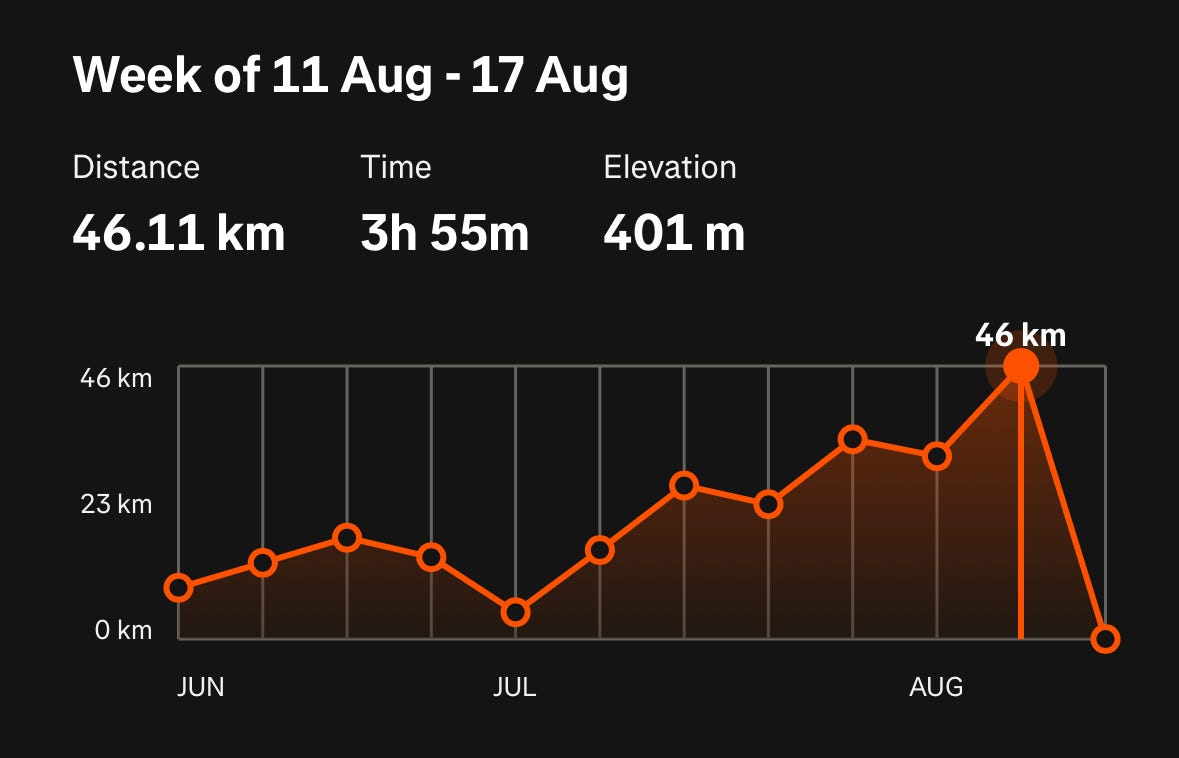
Background
In March 2024, I was diagnosed with a femoral neck bone stress injury on my left side. Nine months later, in December 2024, I developed the same injury on my right side. This was most likely caused by underfueling, which caused me to suffer from chronic RED-S (Relative Energy Deficiency in Sport) - you can read more about this experience here.
Although it sounds extreme - it's actually common. Multiple research studies report recurrence rates of bone stress injuries in athletes as high as 21-22% over roughly one year of follow-up, particularly in high-risk sports like running and track and field1. This means that about 1 in 5 athletes who sustain a bone stress injury will suffer another within the following year.
Now, this is for 1 bone injury only. With 2 bone injuries, the risk factor for a third one goes even higher. Realizing this would become a significant challenge, I decided to do things differently this time. Instead of doing my entire programming alone, I've been lucky to assemble an A-team to support me in my comeback, including Marco Altini, my coach, Brad Beer, my physio, and Danielle de Francesco, my nutritionist. Below I outline the approach I've been taking with them over the last 12 weeks and what I've learned from it, in the hopes that this will reach many other athletes who might be struggling with the same.
The Return to Run Protocol
Cross Training
Before we jump into the running program, let me detail my cross training activities throughout this period, which are also very important for my comeback.
Cycling
Throughout the entire return to run program, I've been riding indoors between 2-3x/week, reaching 1h30-3h30 of volume on the bike. The setup is always the same: 1x easy 1h ride, 1x VO2 max ride (say 6x 3min RPE 9, 1:30min RPE 1) for a total of 50min, 1x 1h30 easy ride. This is meant to stimulate my aerobic fitness without adding any weight-bearing stress.
Strength Training
I could have also called this physiotherapy :-)
I meet with Brad every 6 weeks to adjust the training. This has roughly been the structure of my workouts:
Weeks -4 to 0 (prior to back to running)
2-3x week
Bulgarian split squats, 4 x 10
Bilateral isometric long leg bridge, 4 x 30s
Lateral jumps, 4 x 15
Single leg calf raises, 3 x 25
Doorway Assisted Pogo Hops, 3 x 20
Weeks 1-4
2-3x week
Isometric chair hamstring bridge, 5 x 20s
Lateral jumps, 4 x 15
SL Squats, 4 x 8
Kettlebell Bulgarian Squats, 4 x 8
Natera ankle iso push, 12 x 5s
High hurdle hops, 5 hurdles x 8
Single leg calf raises, 3 x 40 - this burned!
Adductor Ball Squeeze, 12 x 10s
Single Leg Step Jump Ups, 4 x 10
Weeks 5-11
2-3x week, modified following discomfort in the hip joint (more about this below)
Isometric chair hamstring bridge, 4 x 30s
Dumbbell Calf Raise, 4 x 10
30-45cm drop jump, 5 x 8reps
Side Bridge Dumbbell Twists, 3 x 15
Heel raise pulsing, 3 x 1min
Adductor half plank, 3 x 30s
Adductor Isometric Chair Bridges, 4 x 45s
Lateral jumps, 3 x 15
Weeks 12+
2-3x week
30-45cm drop jump, 5 x 8reps
Dumbbell Calf Raise, 3 x 8
Side Bridge Dumbbell Twists, 3 x 20
Isometric chair bridge, 3 x 20s
Chaos Hops, 4 x 20
What I noticed about this program:
Sometimes less is more. When programming for myself, I'd probably done way too much, way too heavy, way too soon.
Plyometrics for the win. I'm doing a lot less weights and a lot more agility stuff like jumping than I've ever done before, and it feels great.
Running
Finally, the best part.
Week 1: Run-walk
2 sessions: 5 x (1 min run, 2 min walk)
1 session: 5 x (2 min run, 2 min walk)
Total weekly running: 20 minutes
Week 2: A little more run-walk
2 sessions: 5 x (3 min run, 2 min walk)
1 session: 5 x (2 min run, 2 min walk)
Total weekly running: 40 minutes
Week 3: 4 sessions of run-walk
3 sessions: 5 x (3 min run, 2 min walk)
1 session: 6 x (2 min run, 2 min walk)
Total weekly running: 57 minutes
Week 4: 10min continuous running
2 sessions: 5 x (3 min run, 2 min walk)
1 session: 2 x (10 min run, 2 min walk)
Total weekly running: 50 minutes
Despite the minimal volume, I experienced significant muscle soreness after the 4th week, indicating substantial deconditioning following the extended time off.
Week 5: Pain, Load Management & Strength Training Modification
At the end of week 4, after completing my first continuous runs exceeding 5 minutes, I developed localized pain at my previous injury site (on the right). I rightfully became worried and decided right away to back off. I took the 5th week almost off (1 run only) and decided to wait to come back until I'd speak with Brad, my physio.
Luckily, after some (remote) tests with Brad, he confirmed that my pain revealed tendon irritation and hip joint inflammation rather than a recurring bone stress injury (phew!). The issue appeared to stem from concurrent hip loading through both running and strength exercises (Bulgarian split squats, weighted squats). Both were just too much for my hip joint, so we right away modified my strength training to exclude all movements involving my hip joint.
Week 6: First 20-minute continuous run
2 sessions: 5min walk, 20min run
1 session: 2 x (10 min run, 2 min walk)
Week 7: Transition to continuous running only
2 x 30 minutes easy
1 x 45 minutes easy
1 x 30min easy + strides - First time adding "intensity"
Week 8: Introduction of strides
1 x 30 minutes easy
1 x 40 minutes easy
1 x 40min easy + strides - Second time adding "intensity"
Week 9: Very similar to previous week
1 x 30 minutes easy
2 x 45 minutes easy
1 x 55 minutes easy + strides
Week 10: First tempo workout
1 x 40min easy + strides
1 x 60 minutes easy
1 x 25 minutes easy + 15 minutes tempo
Week 11: First fartlek workout
1 x 40min easy + strides
2 x 60 minutes easy
1 x Fartlek (2 x 90" + 4 x 60" + 4 x 30" + 4 x 15")
Week 12: Deload week
After 11 weeks of progressive loading, I'm currently taking a planned week of almost complete rest from running (1 session only). Recent research suggests strategic rest weeks every 12 weeks may help prevent bone stress injuries in returning athletes, particularly those with previous bone stress injury history.
Key Observations From This Program
Extended walk-run period: It took 6 weeks before running continuously for 20 minutes! This is substantially longer compared to what I have ever done, but necessary given my injury history.
Soreness as a guide: Significant muscle soreness from minimal running (1-3 minute intervals) indicated genuine deconditioning and validated the conservative approach.
Load interaction: The week 4 incident highlighted the importance of considering total mechanical load across all training modalities, not just running volume.
Professional monitoring: Having experienced physiotherapy support allowed for quick differentiation between bone stress and soft tissue irritation, preventing both unnecessary panic and dangerous progression.
Cadence Modification
My running cadence has always been on the lower end: between 160-165 steps per minute—significantly lower than the commonly cited ideal of 180spm2.
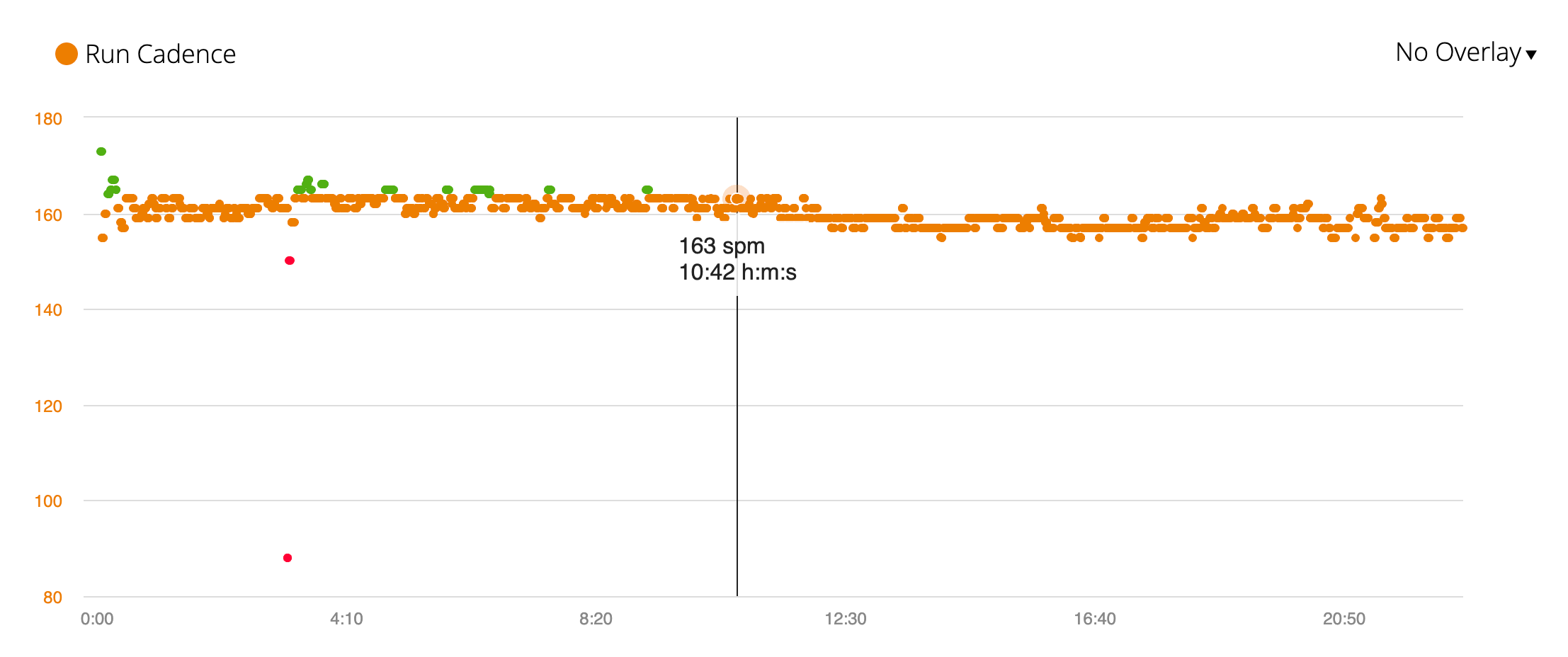
My run cadence for a run done in early May 2025, at an average pace of 5:11min/km
Lower cadence is associated with increased ground reaction forces and greater hip and knee loading, particularly relevant for femoral neck stress injuries. After speaking with both my coach, Marco Altini, and my physio, Brad Beer, I finally decided to tackle this challenge. It seemed relevant after all these injuries.
I began using a metronome on most runs, initially targeting 170spm. The adjustment felt unnatural and awkward at first, but after a few weeks I already noticed this feeling more natural. Now, I'm targeting 175spm when running with a metronome and it already feels natural. Most impressively, my natural cadence without the metronome has increased to 170-172spm for easy runs ~5min/km (which is a crazy difference from 160spm!), and it honestly feels much nicer on my legs.
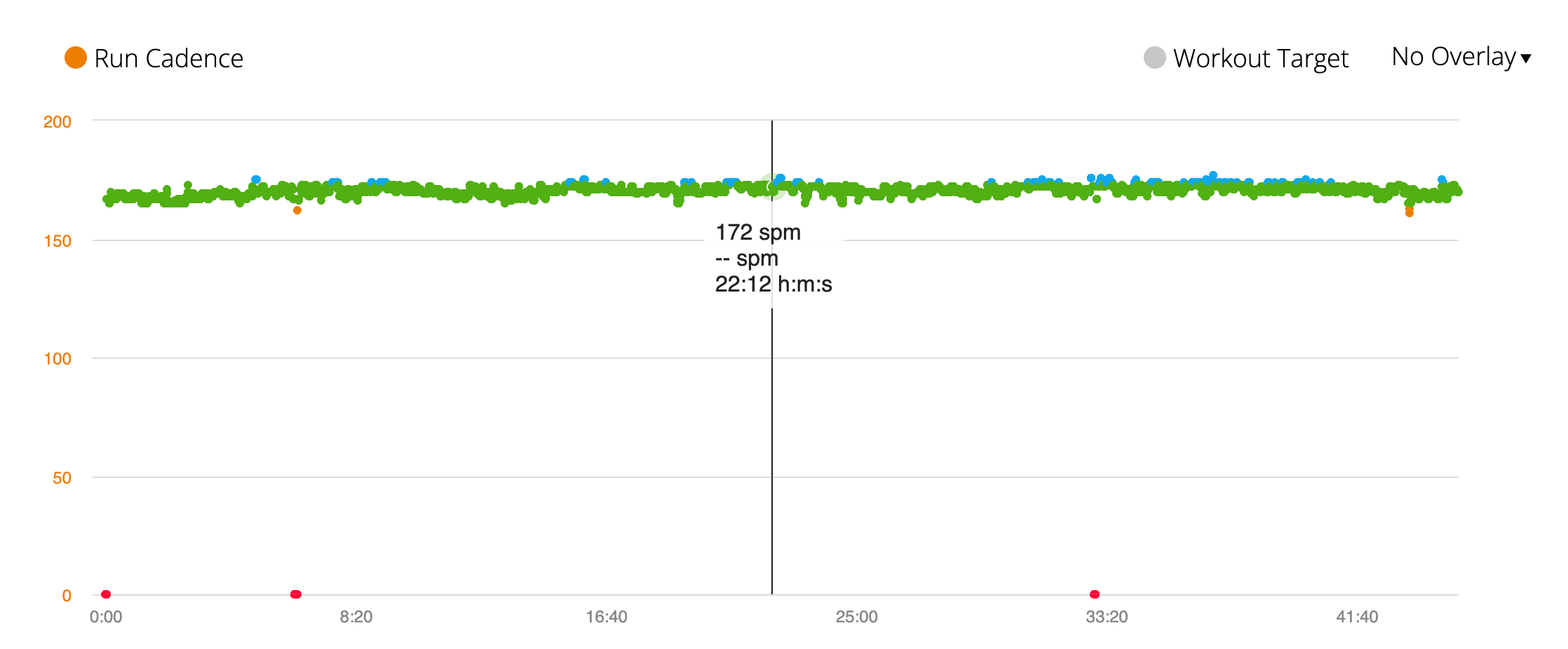
My run cadence for a run done on 1st of August 2025, at an average pace of 5:14min/km
Key observations:
Initial cadence: 160 spm
Current target with metronome: 175 spm
Natural cadence without metronome: 172-174 spm
No hip pain reported since implementing cadence changes
While it's too early to establish causation, the temporal relationship between cadence modification and absence of hip symptoms is noteworthy. Research supports that increased cadence reduces peak hip adduction angles and moments, potentially relevant for femoral neck loading.
Practical Takeaways
The protocol outlined here is specific to my situation (recurrent femoral neck stress injuries) and was developed with professional guidance. Individual protocols should be tailored based on injury location, severity, and athlete history. That said, here are practical takeaways from my journey that may help other athletes facing similar challenges:
Consider starting with 1-2 minute run intervals, even if this feels excessively conservative
Monitor total mechanical load across all training activities, not just running, adjust as needed
Assess running cadence and consider modification if below 170 spm, particularly for hip-related injuries
Use a metronome for cadence training; expect a few weeks for adaptation
Respect muscle soreness in early stages as a sign of adaptation
Work with professionals experienced in bone stress injury management
Plan strategic rest periods even when feeling healthy
My Team
A big thanks to everyone involved in this journey. I wouldn't be here without you!
Physiotherapy: Brad Beer (Pogo Physio)
Coaching: Marco Altini
Nutrition: Danielle De Francesco (Pogo Physio)
augo is launching in November. Sign-up for early access & stay in the loop for product updates
Did you find this content useful? Do you want to support us?
augo’s content will always be free. You can support us by sharing this post, sharing our substack and following us on instagram.
https://pmc.ncbi.nlm.nih.gov/articles/PMC8073721/
https://strengthrunning.com/2020/02/best-running-cadence-step-rate/