The Discipline You Use on Race Day Is Missing From Your Training
Most age-group athletes don’t get faster from training more. They get faster from executing what they already do with more discipline. After 25 years of coaching triathletes and runners, that’s the moment I’m always working towards — when the training looks the same on paper, but the quality quietly shifts.
Here’s the strange part: nobody questions discipline on race day.
Heart rate zones, power targets, pace windows — in age-group racing, having a plan is just what you do. Planned, discussed, mostly followed. So why does that same discipline so rarely show up in training, where it actually builds the engine?
“I just briefly pushed over that little hill”
When I ask athletes what happened in a session, the answer usually comes quickly. Four words show up again and again — more often, I’ll admit, from the men:
“Well, they were just really quick efforts.” “I only meant to push briefly over that climb.”
Well. Just. Only. Quick.
The power meter has no filter for good intentions.
Volker was preparing for long-distance triathlon on eight hours a week — work didn’t allow more. Without thinking about it, he’d push out of the saddle over every small rise. Barely noticeable to him. In the data: spikes between 400 and 550 watts at an FTP of around 230. Each one 10 to 20 seconds — short enough to dismiss, long enough to throw the metabolism off for several minutes. Twenty times per session.
That’s not base training anymore.
Thomas had the same pattern. At one point I counted the outliers manually to make it concrete for him: 57 efforts above 180% of FTP, each longer than 8 seconds — all out of the saddle. He hadn’t noticed a single one while riding.
This is exactly where a power meter earns its keep for age-group athletes — not on race day, but in training. Heart rate filters these spikes out. The power meter doesn’t.
It shows up most clearly in long-distance triathlon, where intensity distribution has to be precise because race day demands exactly that. But the principle travels: cycling marathon, road marathon, ultra-trail. The longer the effort, the more expensive every unnecessary spike becomes. The events differ. The discipline doesn’t.
What the analysis actually shows
Averages hide everything that matters. The story lives in the distribution.
For base sessions, the Variability Index (VI) target is below 1.10. What I see regularly in age-group athletes: 1.25 to 1.40 over two and a half hours. Or look at the power distribution — when no single zone dominates, there’s no specific stimulus. Either you’re getting nothing meaningful, or you’re getting a stimulus you didn’t ask for.
With running, the picture flips. Often there’s just one stimulus — a blend of everything. Hard sessions drift slower because it hurts. Easy sessions drift faster because it gets boring. The result is the same: nothing specific.
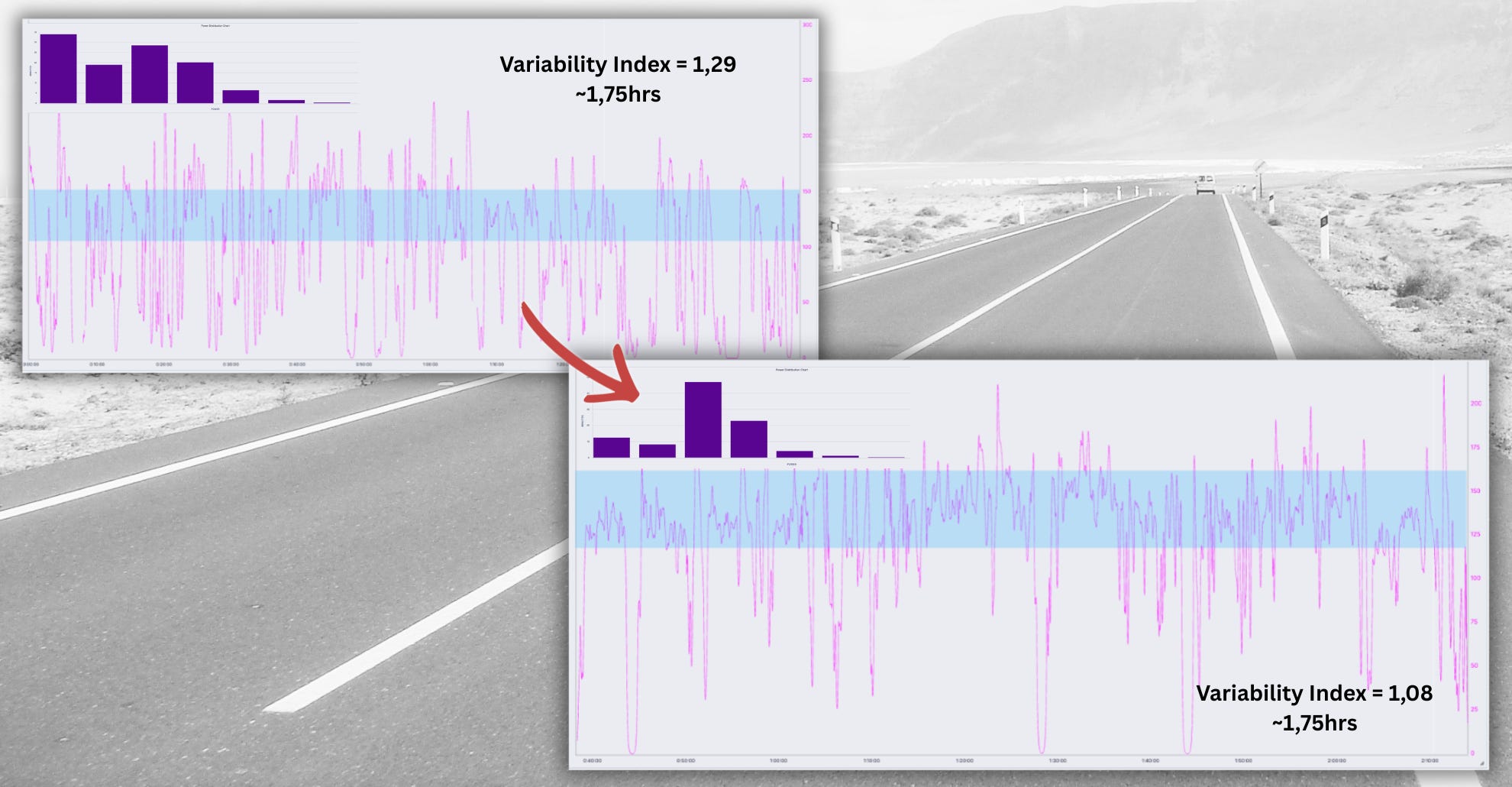
This kind of analysis used to take me 45 minutes per athlete — clicking through curves, counting outliers segment by segment. With augo, it’s one prompt:
“Analyze the progression of the last four weeks. Compare the Variability Index and Power Distribution for outdoor rides. Focus on the clean blocks after the initial stop-and-go city sections. Evaluate whether he is clustering power more effectively around target zones or still relying on micro-surges to hit his averages.”
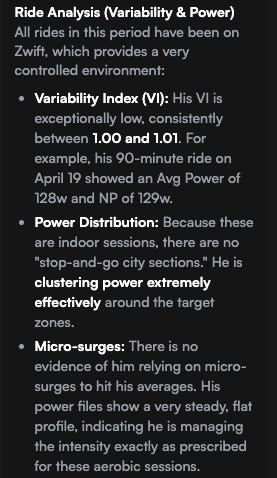
One question. Weeks of data, surfaced in seconds. No tab-switching, no manual counting. The kind of insight I used to dig for now arrives in a single conversation. (I may have added a tweak or two of my own afterwards — but that’s another story. 😉)
A little discipline — for the biggest fans
It eventually clicked for Volker. The sessions got cleaner. The performance jumped. On eight hours a week, he didn’t just finish his long-distance race — he finished it well.
Training more efficiently doesn’t mean training more. It means getting the same result, or a better one, with less.
The biggest fans are at the roadside on race day. But they’re also at home, waiting for training to finish. A little more discipline in training sometimes means a little more time for them. As footballers say: dedicating the result to the fans.
The goal isn’t perfection. It’s optimization — in a way that still feels good. And in the long run, enjoying the training is the most important factor of all.
So — what does your training data actually look like, beyond the average? Is it focused, or did the boys just go for a quick ride?
Drop a comment below — I’d love to hear what your VI looked like the last time you checked.
About the author
Markus is an endurance coach based in Austria with 25 years of experience in triathlon, running, and swimming. He works with age-group athletes from beginners to competitive racers, with a focus on structured, quality-based training and smart execution. Find out more at mytrainair.at.
Markus is also an augo founding coach. With us since the beginning, helping us bring to life our vision. Thank you, Markus!
We leave you with Markus’s words about augo:
In 25 years of coaching, I’ve watched the pendulum swing from athlete feedback to athlete data. What once felt like a handful of data points has turned into hundreds. The truth sits somewhere between what the athlete feels and what the data shows. augo helps me get there faster. It surfaces patterns and connections, and my coaching perspective helps turn them into better decisions. That’s the future of coaching.