The Hidden Cost of Going Ultra: When Training Volume Becomes a Risk Factor for Eating Disorders
Ultra races - anything beyond the marathon distance (26.2 miles / 42.2 km) - are starting to take the marathon’s old spot as the go-to big goal. Participation has surged in recent years, with ultra events filling up fast. But going longer also means putting in more hours and volume into training, which comes at a cost: higher prevalence of disordered eating.
A new study in Frontiers in Sports and Active Living reports a worrying link between high-volume endurance training and disordered eating. Among 531 ultra-endurance athletes surveyed, 11% scored above the screening cutoff for eating disorder risk, and 20.3% reported at least one disordered-eating behavior that warrants professional evaluation.
Perhaps most concerning: training volume itself appears to be a significant driver of this risk. The more hours athletes trained per week, the higher their likelihood of showing signs of disordered eating. The researchers identified a specific threshold, 14 hours per week, above which eating disorder risk appears to climb substantially.
Key Takeaways
Training volume was a stronger predictor of eating disorder risk than age or gender
11% of ultra-endurance athletes in a new study scored above the clinical threshold for eating disorder risk
20.3% exhibited at least one behavioral symptom of disordered eating
14 hours per week of training was identified as a threshold for heightened eating disorder risk
The unique culture and demands of ultra-endurance sports may normalize concerning eating behaviors
Broader research shows 32-62.5% of ultrarunners may be at risk for eating disorders
The Paradox of Extreme Fitness
The lead author of the study, Jill Colangelo from the University of Bern, and her colleagues set out to investigate something that’s been largely overlooked in sports medicine: the psychological vulnerabilities that may come with the extreme training demands of ultra-endurance sports.
“While moderate exercise can have an advantageous impact on mental health and wellbeing,” the researchers write, “it is unknown whether this extends to the often substantial volumes of physical activity inherent in ultra-endurance sports.”
Unlike traditional elite sports, where only the top level athletes train at extremely high volumes, ultra-endurance sports are characterized by high training volumes across all ability levels. Whether you’re aiming to win an ultramarathon or simply finish one, you’re likely training 15, 20, or even 30+ hours per week.
What the Numbers Tell Us
The researchers recruited 531 ultra-endurance athletes through popular endurance sports websites, newsletters, and social media groups. Participants ranged from 19 to 73 years old, competed in sports including ultrarunning, trail running, triathlon, ultra-cycling, and more, and were categorized into three training volume groups: less than 10 hours per week, 10-20 hours, and more than 20 hours.
Each participant completed the Eating Attitudes Test-26 (EAT-26), a validated screening tool that assesses attitudes and behaviors related to eating disorders.
The results were striking:
Training volume was the strongest predictor of eating disorder risk. It’s more significant than age or gender, though both contributed. Athletes training more than 20 hours per week had average EAT-26 scores of 16.42 (higher scores indicate greater risk), compared to 9.78 for those training 14-20 hours, and just 6.42 for those training under 14 hours.
When researchers analyzed behavioral symptoms, things like binge eating, self-induced vomiting, laxative use, and excessive exercise for weight control, the pattern held. Those training over 20 hours per week were significantly more likely to report these concerning behaviors.
Using statistical analysis (ROC curve analysis, for the technically minded), the researchers identified 14 hours per week as the threshold at which eating disorder risk begins to increase meaningfully. Above this line, something appears to shift.
The 14-Hour Threshold: What Does It Mean?
It’s worth being careful about how we interpret this finding. The study doesn’t claim that training 14+ hours per week causes eating disorders. The researchers explicitly note that causation can’t be established from this cross-sectional design.
But the threshold does serve as a warning signal. As the authors put it, it’s “an indicator of heightened vulnerability, suggesting that increased training volume alone may contribute to elevated ED risk.”
What’s particularly concerning is that for many ultra-endurance athletes, 14+ hours of training per week is just... normal. It’s the minimum volume needed to adequately prepare for events like 100-mile ultramarathons or Ironman triathlons.
This creates a difficult situation. The very preparation required for these sports may push athletes into a risk zone for disordered eating.
Why Would Training Volume Increase Eating Disorder Risk?
The researchers offer several possible explanations, and the picture that emerges is more nuanced than simple cause-and-effect.
The Energy Balance Challenge
Ultra-endurance athletes face a unique nutritional challenge. A 100-mile ultramarathon can burn more than 15,000 calories. Even in training, long endurance sessions create substantial caloric deficits that must be replenished.
This creates what researchers call “chronic caloric debt”, a state where athletes consistently expend more energy than they consume. Over time, this can lead to Low Energy Availability (LEA), a condition associated with a cascade of health problems including hormonal disruption, bone density loss, impaired immunity, and increased risk of eating disorders.
The phenomenon is increasingly recognized as Relative Energy Deficiency in Sport (RED-S). A 2023 systematic review found that among ultra-endurance runners, eating disorder prevalence ranged from 32% to 62.5%, rates far higher than the general population’s estimated 7.8%.
The Fitness Tracker Effect
The study also pointed to an interesting finding: one of the most common responses on the eating attitudes questionnaire was “I am aware of the calorie content of the foods that I eat.”
In the age of Strava, Whoop & nutrition apps, ultra-endurance athletes have lots of data about their training, performance, and nutrition. While these tools can be helpful, research has increasingly linked their use to obsessive behaviors around food, body image concerns, and exacerbation of eating disorder symptoms.
Cultural Normalization
There’s something else at play that the researchers highlight: the culture of ultra-endurance sports may normalize behaviors that, in other contexts, would raise red flags.
Ultra-endurance athletes often develop intense relationships with food and nutrition. Given the extreme energy demands of their sports, this focus makes sense. But it can also provide cover for disordered patterns.
As one ultra-runner quoted in a related study put it: “I’ve been socialized to feel guilty for eating, even though I’m hungry and need fuel.”
The sport’s culture also tends to celebrate extreme behaviors. Athletes describe their training habits as “insane” or “crazy”, terms that might seem concerning from the outside but are worn as badges of honor within the community.
The Bigger Picture: Mental Health in Ultra-Endurance
This study adds to a growing body of evidence suggesting that ultra-endurance sports, despite their health associations, carry genuine mental health risks.
A 2023 systematic review in Sports Medicine synthesized data from 3,670 ultra-endurance runners and found concerning prevalence rates across multiple conditions:
Eating disorders: 32-62.5%
Exercise addiction: 11.5-18.2%
Depressive symptoms: 18.6%
Sleep disturbances: 24.5%
These aren’t numbers you’d expect from a population often assumed to be among the healthiest on the planet.
The research suggests that the relationship between exercise and mental health isn’t linear. While moderate exercise consistently shows benefits for mood, anxiety, and depression, there appears to be a point at which more is no longer better and may actually become harmful.
The Path Forward
This research doesn’t suggest that ultra-endurance sports are inherently harmful, or that everyone training over 14 hours per week is at risk. The authors are careful to note that individual responses vary substantially.
But it does call for a shift in how we think about extreme fitness. The same traits that enable athletes to complete ultra-endurance events—discipline, pain tolerance, mental toughness, perfectionism—can also make them vulnerable to pushing beyond healthy limits.
As ultra-endurance sports continue to grow in popularity, the question isn’t just how to help athletes go further and faster. It’s how to ensure that the pursuit of extraordinary physical achievements doesn’t come at the cost of mental health.
The researchers’ conclusion is pointed: “Given the growing popularity of UES, better education on the risks associated with high training volumes may be necessary to promote healthier training practices.”
Perhaps it’s time to expand our definition of what it means to be a healthy athlete, one that includes not just physical capability, but psychological wellbeing too.
How we are addressing this at augo
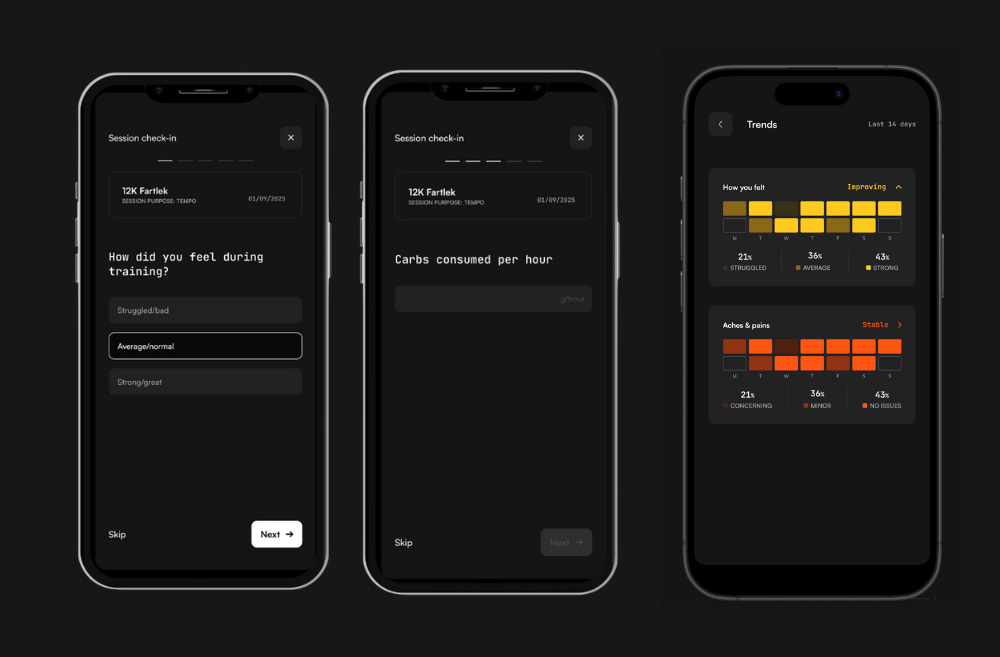
Signals on suboptimal fueling by athletes through session feedback can be important for coaches to spot disordered eating. However, this is exactly the kind of signal that gets lost in today’s coaching tools. A comment about skipping meals, a pattern of low energy reported, declining carb intake session after session. These are early warning signs, but only if someone is tracking them consistently and can see the trend.
augo’s structured session feedback gives coaches the ability to do exactly that. Coaches choose their own feedback questions. Things like “energy levels before session” or “carbs consumed per hour” and athletes answer them after every workout. Over time, this builds a trend view that makes subtle patterns visible before they escalate. Instead of relying on memory or scattered WhatsApp messages, coaches have a structured, longitudinal picture of how their athletes are really doing, helping them intervene earlier, have the right conversations sooner, and ultimately keep their athletes healthier.
References:
Colangelo J, Smith A, Bitterlich N, Buadze A, Liebrenz M (2025). Risks for eating disorder in ultra-endurance athletes and the role of training volume: a cross-sectional study. Frontiers in Sports and Active Living 7:1708869.
Thuany M, Viljoen C, Gomes TN, Knechtle B, Scheer V (2023). Mental Health in Ultra-Endurance Runners: A Systematic Review. Sports Medicine 53(10):1891-1904.
Mountjoy M, et al. (2023). 2023 International Olympic Committee’s (IOC) consensus statement on Relative Energy Deficiency in Sport (REDs). British Journal of Sports Medicine 57(17):1073-1097.