The Limits of AI Training Plans: What a Doctor of Physical Therapy & run coach wishes you knew

About the Author: Megan Edwards is a Doctor of Physical Therapy and run coach based in New York, NY. She specializes in treating endurance athletes and has been coaching runners since 2022.
Fun fact: Megan and Bruna (augo founder) ran collegiate XC and track & field together at Emory University.
Megan is part of augo’s founding coaches: A select group that has early access to the App.
In this article:
AI plans are at first sight “personalised” but they are not the same thing as working with a coach and that distinction matters far more than most runners realize.
Training errors drive the majority of running injuries.
Many AI marathon plans push too much intensity.
Prior injury changes risk, and most AI plans don’t account for it well.
AI assumes ideal recovery, while a coach adjusts when life changes what you can handle.
Want to write a piece for augo, too? We feature coaches from our community every month across our Substack and social channels.
At first glance: fast, cheap, and “personalized”
At first, the appeal of AI-generated training plans is obvious. With a few prompts, ChatGPT can produce a free, polished marathon plan in seconds.
Platforms like Runna offer plans based on your goal pace for a fraction of the cost of working with a human coach. Runners enter their race date, preferred mileage and available training days, and the result feels personalized and efficient.
These tools are affordable and accessible - it’s no surprise that more runners are structuring their training this way. But a “personalized” training plan is not the same thing as working with a coach and that distinction matters far more than most runners realize.
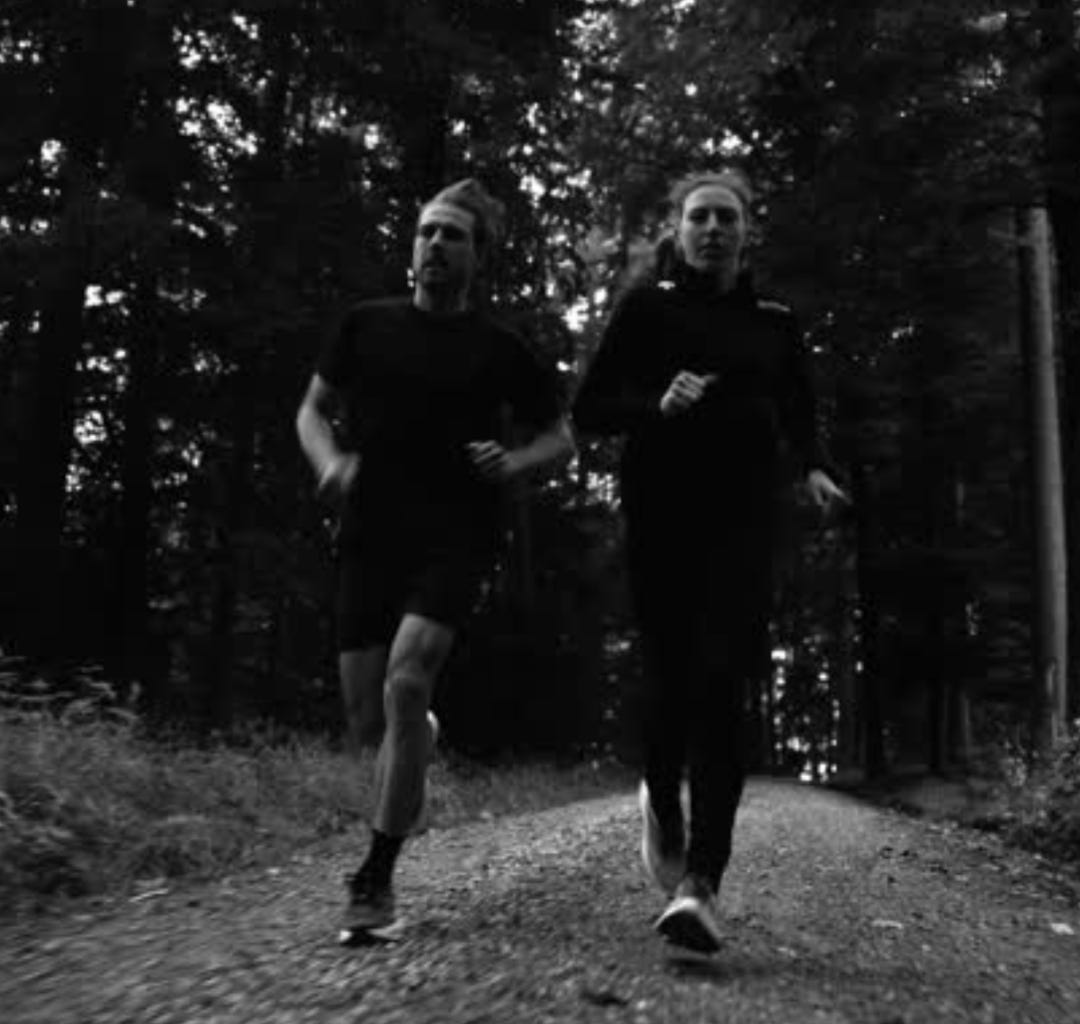
Most running injuries are predictable
The evidence is clear: training errors drive the majority of running injuries. Yet many runners I work with are quick to frame their latest injury as random.
When we take a closer look, however, these injuries are rarely mysterious. In retrospect, they are usually predictable once we examine training load, recovery capacity and injury history together.
Your body does not experience training as a weekly Strava total - it experiences it day by day.
Training load is more than weekly mileage
Most AI programs rely on linear progressions in weekly mileage, occasionally punctuated by a down week. But the training load is not solely defined by mileage.
Your body responds to a constellation of factors:
the length of your longest run
how many days per week you train
whether those days are back-to-back
the introduction of speedwork or hills how intensity is distributed across the week
Overuse injuries often arise when these variables change too quickly or without sufficient attention, even if weekly mileage appears reasonable on paper.
The intensity problem (tempo/ threshold/ race pace)
AI-generated marathon plans tend to overemphasize threshold, tempo and race-pace running. For runners who are already well-adapted to frequent intensity, this approach can be effective - assuming their bodies can tolerate the accumulated stress.
But many runners are investing in these apps because they are training for their first or second marathon and I can almost guarantee they do not need three days of speed work per week in the form of strides, tempo runs, and marathon-pace segments layered into long runs for a healthy, successful race day.
Excessive intensity, particularly when layered onto increasing volume, is one of the most consistently identified risk factors for injury.
Prior injury changes everything
Perhaps the most significant limitation of AI, however, is its inability to meaningfully account for prior injury - and the heightened risk that follows.
One of the strongest predictors of an overuse injury in runners is a history of previous injury, especially bone stress injuries. Yet AI plans do not account for this physiological history.

Real-life recovery isn’t “ideal conditions”
To complicate matters further, AI implicitly assumes ideal recovery conditions: adequate sleep, optimal nutrition, low life stress, and perfect health.
For most runners I know (and work with) this simply isn’t reality. Nor should it be - we’re human. Recovery will always compete with work, relationships, travel and the inevitable stressors of daily life - which aren’t totally measurable, even if you have a Whoop or an Oura ring (despite what their marketing teams say).
A coach knows to adjust tomorrow’s long run if you’re coming off a poor night of sleep, recovering from a cold, or navigating an especially demanding work week. AI does not.

Stress + rigid plans: how runners talk themselves into trouble
Recovery is chronically undervalued in training because it’s difficult to quantify. I ask every new patient I meet about their sleep, nutrition, and stress levels. Most struggle to understand whether they meet general recommendations (whether they’re runners or not).
These needs also shift as training load increases and vary significantly between individuals. A static plan cannot account for that complexity.
Mental and psychological stress are also underappreciated contributors to injury risk. Higher injury rates are associated with increased psychological stress and external pressure.
A rigid plan and lack of knowledge of when and how to modify it can override the body’s internal warning signals. I frequently see runners push through pain on long runs because they “have” to hit the prescribed mileage, or force a peak week because the plan dictates it.
The plan doesn’t know you’re traveling, managing a stressful job, or dealing with an irritated Achilles.
Where AI helps and where it stops
There is real risk in automating training decisions and ignoring these warning signs. Two things derail running progress more than anything else: injury and burnout.
Training is most rewarding when we’re healthy and enjoying the sport. Yet in my field, I see preventable training errors repeatedly turn what should be fun athletic pursuit devolve into a cycle of setbacks.
AI can be a useful starting point. It can provide structure, ideas, and a general framework. But it does not replace a coach.
The true value of coaching lies in monitoring how an athlete responds to training and making timely, thoughtful adjustments. That requires judgment and a thorough understanding of injury history, workload changes, and recovery capacity.
These are not data problems. They are human problems. And for now, at least, they remain firmly outside AI’s reach.
Want to write for Augo as well? We regularly feature coaches from our community across our Substack and social channels.
Sources:
Nielsen et al. (2012), Training errors and running related injuries
Drew & Finch (2016), The relationship between training load and injury
Gabbett (2016), The training—injury prevention paradox
Seiler (2010), Training intensity distribution in endurance athletes
Buist et al. (2010), Incidence and risk factors of running-related injuries
Hespanhol et al. (2016), Previous injuries and running injury risk
Rasmussen et al. (2021), Gender Marginalization in Sports Participation through Advertising