Kraichgau 70.3 Race Report: When the Body Doesn't Show Up
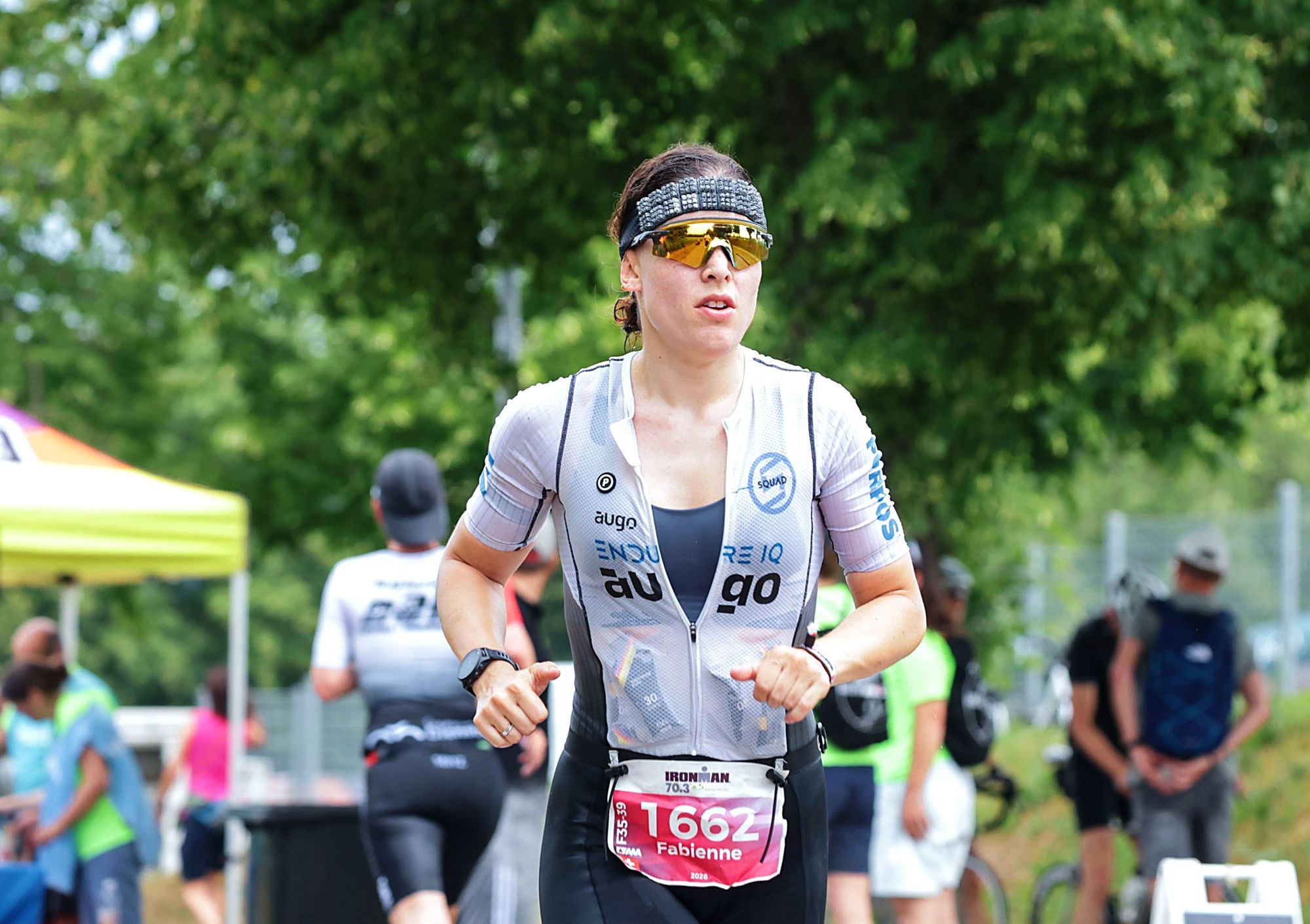
Not every race is one where things go well — especially not in a triathlon. This is the story of my first race of the season that did not really go well, but I’m still proud of finishing.
The build-up to Race Day
Ironman Kraichgau 70.3 was my first 70.3 of the season, and honestly, the lead-up went really well. I felt as fit as ever and confident going into the race. In training I managed to ride 195 W NP for about 1:45 hours in my peak volume weeks. Off the bike I ran some of my best times, with a 4:20min/km pace feeling very comfortable. The swim is always a challenge for me, but even there I felt I’d been improving.
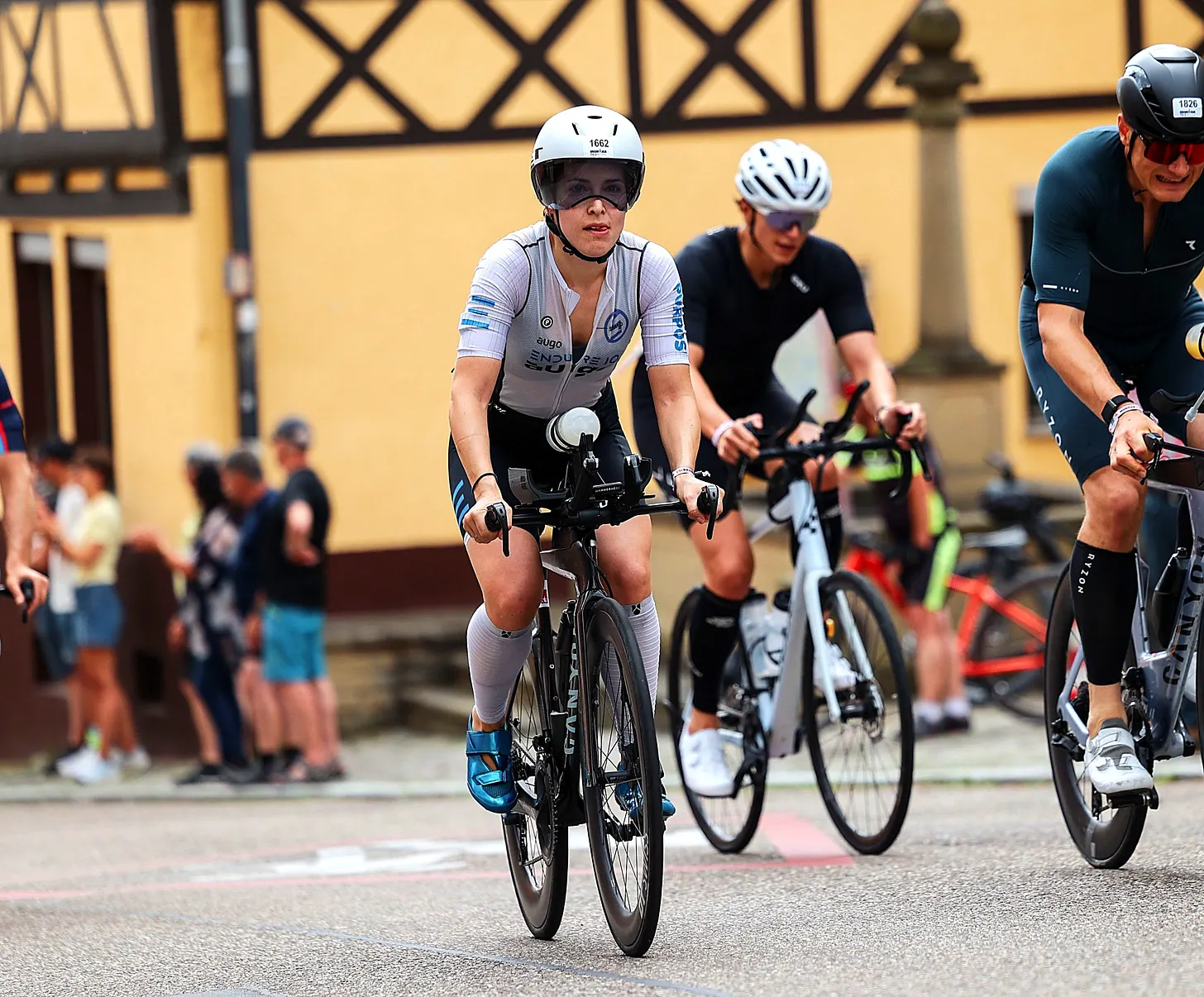
Bike Leg of the IM Kraichgau 70.3
Then life happened ;) One week out from race day was my wife’s birthday, and I had to leave her birthday drinks early because I felt feverish. On top of that, temperatures in Zurich jumped from 17 to 30 degrees basically overnight. No heat adaptation whatsoever.
In augo, my coach and I track how I’m feeling, and one week out from the race, my answers turned more “bad” than my usual “normal”. A quick side note here, because I find this genuinely interesting: I’m a user who is very careful with choosing. I often report feeling “normal” when I feel good, and only “great” if I have an exceptional day. I think it says a lot about how differently people report subjective feeling — something we think about a lot at augo.
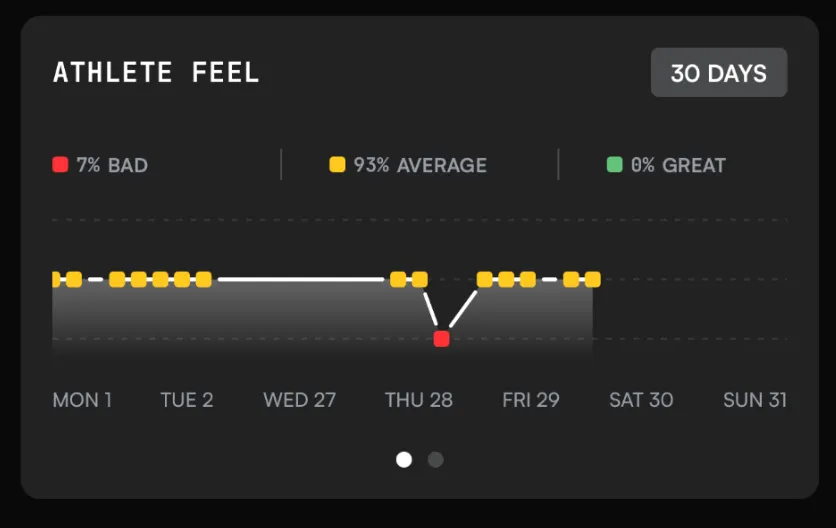
Tracking Feel Post-Session in augo.
The Monday before the race I felt better — the worst of the illness was over. But I felt flat. I think it was a mix of the heat and that post-sickness lack of energy. My HRV, which I track in HRV4Training, confirmed what I was feeling.
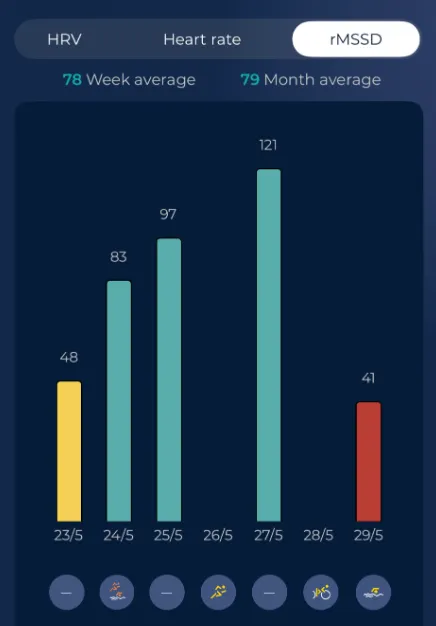
Tracking my HRV in HRV4Training
So this is a race report about a race that didn’t go to plan. A day where the body genuinely didn’t show up, and where the most interesting thing I learned came from accepting that instead of fighting it. Not every race is going to be your day. Sometimes you just don’t have it. And I think that’s worth writing about too.
What the legs could do three weeks earlier
Bear with me on the numbers here, because they matter for the rest of the story. Three weeks out, healthy, I did a continuous TT effort on the bike: around 195 watts NP held for 1 hour 45mins, heart rate sitting at 155 bpm — steady the whole way, no fade or drift. At my 235 W threshold, that’s an intensity factor of about 0.84.
That’s a strong, repeatable engine, and it was trending up. My threshold had climbed to around 235 W at about 61–62kg — the fittest I’ve been going into a 70.3. So when I tell you the bike fell apart at Kraichgau, keep that baseline in mind: I arrived in the best shape of the three races I’ll compare below.
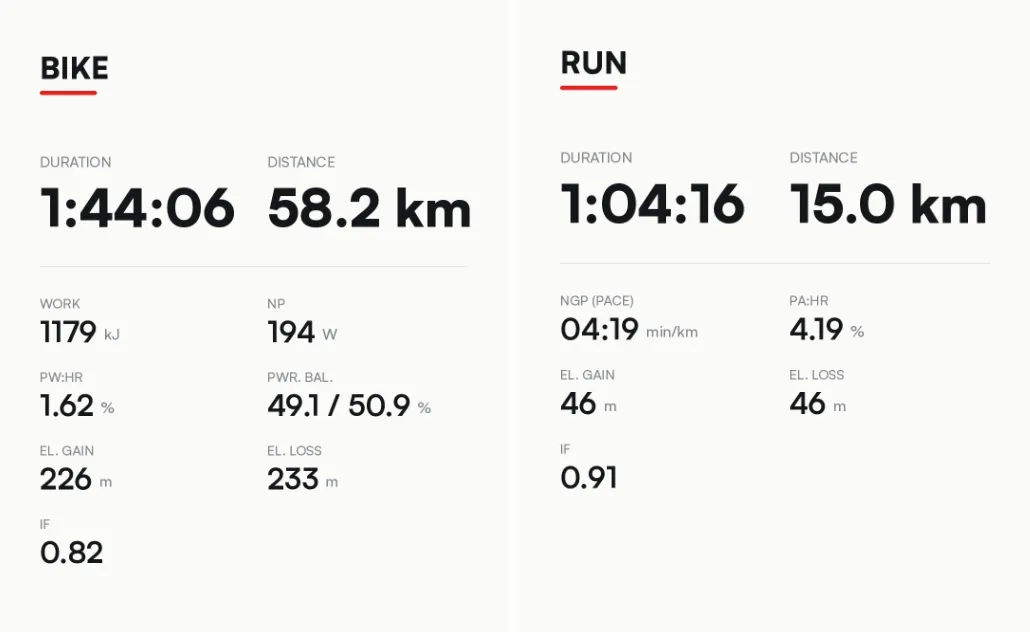
Bike Interval and Run off the Bike Sessions in my Peak Volume Phase in the build-up for Kraichgau.
The Swim: 35 minutes, 1900m
The swim started at a lake around 8:30am, wetsuit legal for the age groupers. I started and felt ready to go. Swimming is my weakest discipline, and it did feel hard. Getting close to the end, my arms got quite tired — which was odd, as I normally don’t have that feeling. Swim done. 35 minutes, 1:51min/100m. Nothing special, nothing terrible. I got through it. It’s also worth noting that I swam without a watch, because I did not want to know the time I am swimming (I did not want this to get in my head).
The Bike: where things fell apart
At Kraichgau I rode a normalized power of 165 W, average 155 W, over 2:44:49 for 88 kilometres on a course with nearly 1,000 metres of climbing. IF 0.70. Compare that to Valencia (NP 185, IF 0.86) and Tallinn (NP 187, IF 0.83), and it looks like I simply rode 20 watts softer.
But the watts aren’t the real story. The heart rate is.
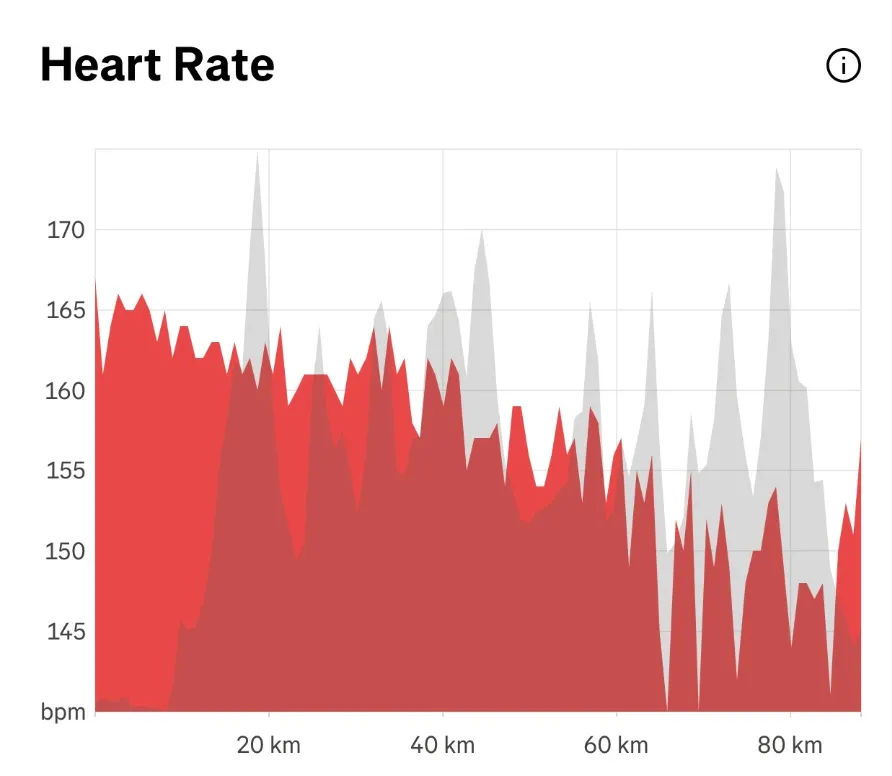
HR dropping as the race went on.
My average heart rate on the bike was 156 bpm — almost exactly the 155 bpm I held during that hour-long TT effort three weeks earlier. Cardiovascularly I was working as hard as a healthy threshold effort, and getting 30 to 40 fewer watts for it.
And it didn’t even hold. Split the ride into thirds, and the power just drains away:
First third: 173 W, HR 162
Second third: 159 W, HR 158
Final third: 132 W, HR 150
(Fueling: 70g carbs per hour)
Power and heart rate sinking together. That’s a sign something is off: it isn’t a discipline problem, it’s a ceiling problem, and the ceiling kept dropping. My body kept telling me the same quiet thing — I had less available, so I used less. The strange upside of that is you stop chasing a number you don’t have. The feedback loop does the pacing for you.
In the end I just wanted to finish that bike leg.
The Run: the part I’m actually proud of
In T2 I took 5 minutes. Mostly because I expected the run to get as hard as the bike, and I was already worried about energy. Honestly, I was dreading it. So I took the transition slowly and jogged into the run leg.
1:35:44. 21.15 km. 4:32/km average. On a run course with about 200 metres of climbing, off the worst bike of my three races, after a sick week.
Put it next to the others: Tallinn 4:33/km, Valencia 4:35/km. The run didn’t just survive — it landed within three seconds per kilometre of my best-ever 70.3 split.
And it got better as it went. The splits stayed flat-to-faster the whole way while my heart rate climbed steadily from the high 150s into the 170s — I found some energy back on the run. Still not the pace I know I can hold, but better than expected. The fastest kilometres of the entire half marathon were the last two: a 4:18, then a closing stretch at roughly 4:09 pace, heart rate touching 177bpm.
I don’t fully understand why the run held when the bike didn’t. Maybe the conservative bike left some energy in me. Maybe running is a different system the flu had less grip on. Maybe I’ve run enough half marathons off the bike that my legs do it half on autopilot ;) Whatever the reason — coming off T2 and running it home like that doesn’t feel like a bad day.
Most importantly: I had lots of fun on the run! Instead of being miserable and punishing myself, I took in the energy of the crowd and just enjoyed it.
Three races, one stubborn pattern
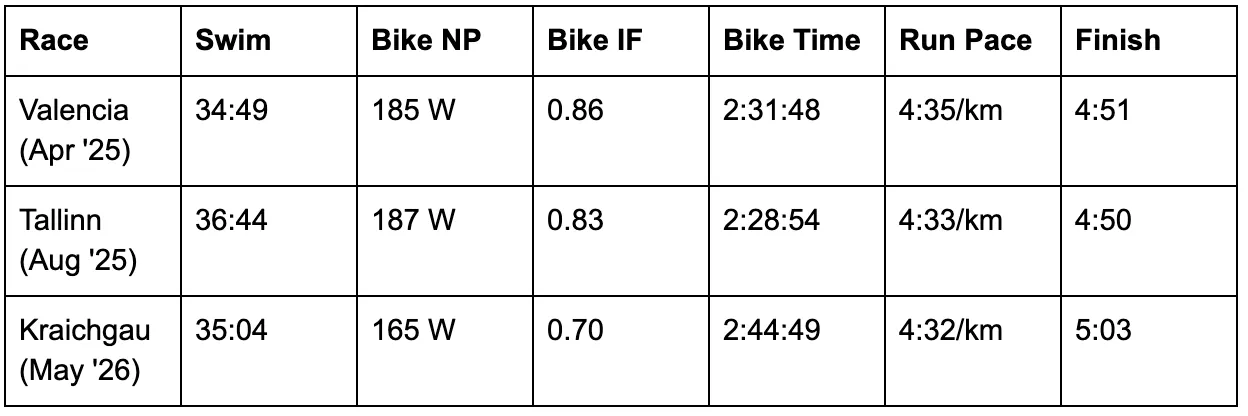
Knowing my bike was off at Kraichgau, the other observation that stands out: my run off the bike keeps creeping around that same 4:3X/km number, no matter what happens before it.
Total: 5:03 — three minutes short, and a full result anyway
Sub-5 would have been great. I finished in 5 hours 3min.
In any other context, those three minutes would gnaw at me. But coming in after a flu week, after a bike split I’d have pulled the plug on in training, after genuinely asking whether I should start at all — 5:03 is a complete result. It was good for 7th in my age group, in a field where the run was seriously competitive.
What I took from it
Racing sick teaches you something you can’t really learn any other way: the difference between what you can push through and what you shouldn’t try to.
The data made that lesson concrete for me. Same heart rate, far fewer watts, an output that drained instead of held — and the right answer wasn’t to force it. It was to ride what I had, let go of the day I’d planned, and save the run. The numbers did the disciplining for me.
I’ve now raced three 70.3s in about 13 months. Valencia was an up and down — I fell apart at 2km into the run and found my legs again near km 12 (though that one came two weeks after a marathon, so bear with me ;). Tallinn was the clean one, everything clicking. Kraichgau was the one where circumstances threw the plan out the window, and I had to figure out what “showing up anyway” actually means in practice.
The answer, for me: not every race gets to be your day. Sometimes the body simply doesn’t show up, and no amount of wanting fixes that on race morning. But you can still show up — start the thing, ride what you’ve got, run it home honestly. And there’s always another race.
What’s next
There’s a big one on the calendar: the World Championship for the Ironman 70.3 in Nice ahead in September (I qualified for that one in Tallinn). Exciting times ahead and I’m excited to push myself to new heights for Nice.
There’s always another race.
Thanks for reading,
Fabi