Adding Quality to Workouts: How Specific Does a Coach Need to Be?

I have always liked the Lord of the Rings books – I actually have a university credit in them! I didn’t care for the movie adaptations; all too often the book is better than the movie. My version of Gandalf or the Shire might be very different from yours, but we both can love Lord of the Rings! Movies often fall short because they take a lot of that thinking and ‘personalization’ away. Movies do the work for us by curating a fully formed version of our favourite story and leaving us to consume rather than interpret and think.
Often athletes will say, ‘just tell me what to do’ or ‘I don’t want to think’, not realizing that they are missing a large component of training. By fully forming a workout, coaches risk being too specific and ending up with a very narrow training environment, much like a director making decisions for the movie-goer. A coach’s fully structured workout is very often not better than the athlete’s interpretation of the coach’s training intention.
In this article
Why a fully structured, over-specified workout is often no better than the athlete’s own interpretation of the coach’s intent.
How to frame a workout as a problem to solve — giving the athlete room to fit it to their day, terrain, weather, and life.
A worked example: one 4 × 8 hard-interval “challenge” and the very different ways three athletes might “solve” it.
How to progress each athlete individually based on how they solved the session, rather than forcing a single template.
Why the athlete’s subjective “story” (who, what, where, when, why, how) matters alongside the power and heart-rate data — and how augo captures it.
Workout Challenges and Solutions
The athlete can and should be trusted to fill in some of the gaps in how to ‘solve’ a workout, because they know what is going on in their life! The athlete knows how they feel, where they are that day, who they can train with, what the weather is like, how much time they have available, how well they slept and what else is going on at work. There is obviously some need to guide younger or newer athletes to help them get the basics of training, but new athletes also do not require overly specific training to progress either!
It is a useful way to think about workouts: as problems or challenges that the athlete can solve. After they try it, we can also nudge them in certain directions with future workout progressions. As an example, let’s say we want to do something like a 4 x 8 hard interval set for a gravel racer. We can detail every element of how we want it done (where, heart rate, bike type, cadence, time of day, power targets, pacing guidance, who is with them) or we can be very open and simply say we would like 4 x 8 minutes of hard intervals, taking 2–4 minutes rest between, on Wednesday.
Possible workout ‘solutions’ based on a 4 x 8 hard interval ‘challenge’:
Athlete uses ERG mode and trains indoors, choosing a cadence at 60rpm, in a very hot environment.
Athlete uses a technical gravel trail with variable power output, hitting the expected power ranges for normalized but not average power. Done on a variety of trail/road sections (not repeats).
The athlete goes very hard and abandons the last interval at 5 minutes — a very hard session. Done as repeats on an industrial paved route (busy with other riders).
Looking at the three solutions above, we can assess how they did and whether we like what the workout looks like. We might just say ‘great job, we will try this again next week’ if it accomplishes the goals. We could also choose to do some coaching now and ask some questions about cooling or fueling, or anything else that might add to the story (of course augo will help with some guided questions after the workout!). Once we have an idea of how they solved the workout, we can nudge them in a certain direction with a challenge for the next workout.
Possible workout progressions customized to each athlete’s solution:
The first athlete could be challenged with a cadence target, or asked to try it with a tailwind, or outside, or with a fan, or even to join a faster group ride to get similar work with higher cadence and coordination. The second might be challenged to repeat the intervals on one portion of their ride to push their effort and average power a little more and get some feedback about distance covered up the hill, while preserving their love of off-roading! The third athlete could be given heart rate limits based on their workout to help them experience a paced workout (e.g. stay under 88% on the first one, 89% on the second one, etc.) and encouraged to try a little less intense environment out of the city, in case it got overwhelming with traffic.
A Real-Life Coaching Exchange in augo Using the Athlete’s Story About the Solution
As a younger coach, I thought workouts had to be ‘perfect’ and that something magical would happen with 3 x 10 minute intervals versus 3 x 9, or at 86% MHR vs. 89% MHR. This (false) precision is often promoted by coaching education and online coach software, but misses the other elements involved in training and racing. Today, I think more about the feeling of workouts and the ‘story’ (who, what, where, when, why, how). What qualitative aspects did the athlete add to the workout story outlined by squiggly heart rate and power graphs? This rich story is beneficial and enjoyable, and opens up many options for the coach to add a challenge or suggestion to the athlete’s story — helping their journey go in the direction of their goals without removing the athlete’s knowledge about their context and preferences from the story!
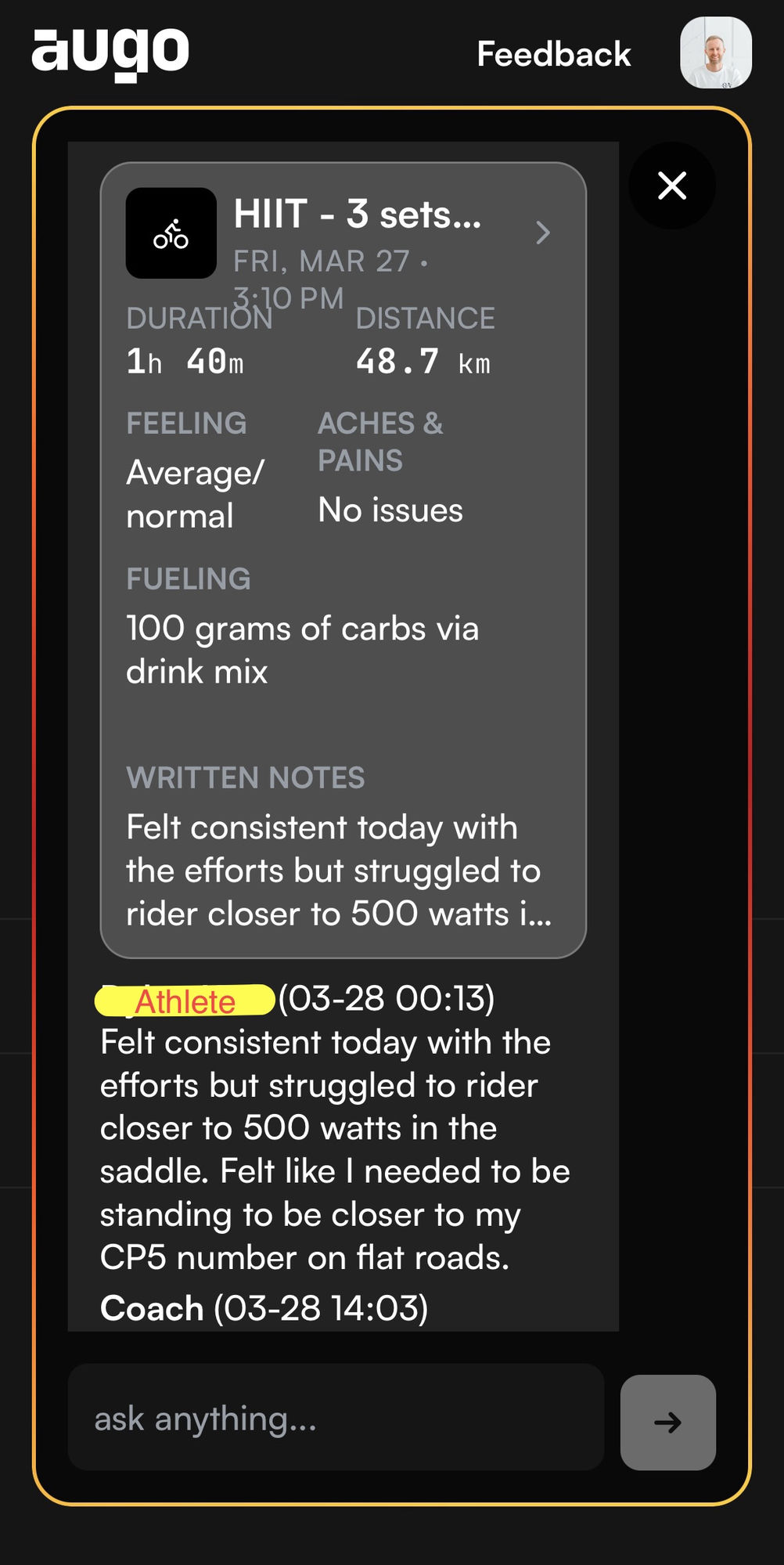
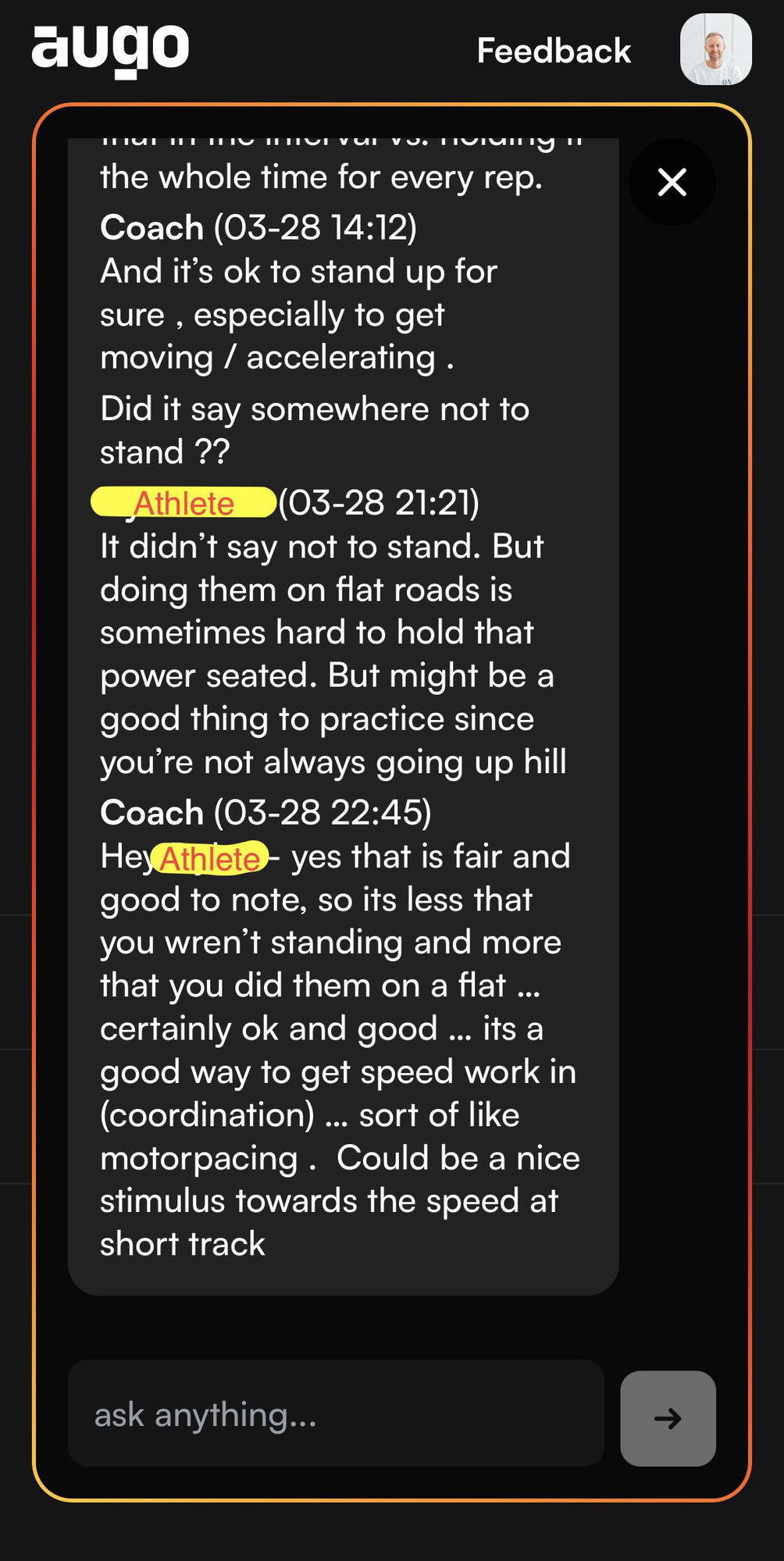
In the screenshots above you can see how an athlete ‘solved’ a workout with micro-intervals (high intensity). In the conversation partially captured in the two images, we talked about things like WHY they used standing to reach the power, WHERE they did it on flat terrain, and HOW that might be beneficial speed work for an experienced mountain biker training for the very high speeds of short-track mountain bike racing.
With augo, the athlete’s subjective story is encouraged and conversations are fostered. These conversations and details help the coach improve the athlete’s training, alongside the data and — importantly — the athlete’s experience. Recurring questions help flag or confirm things like fueling and how the athlete felt about the workout, while the extra comments and the chance to go back and forth allow us to review and plan for the next training session. This is a positive direction for coaches and athletes to learn and progress together.
About the author
Peter Glassford is a Chartered Professional Cycling Coach and Registered Kinesiologist based in Collingwood, Ontario. He helps busy adult athletes build durable habits around gravel, mountain bike, cyclocross, and endurance events, and is an augo founding coach — helping shape the platform since its early days. Thank you, Peter!
Where to find Peter:
Consummate Athlete — coaching, articles & podcast: consummateathlete.com